
One of the many things that make Delhi’s historical architectural heritage so interesting is just how easy most of it is to miss. Yes, a few of the city’s grandest monuments, commissioned by the most illustrious rulers of Delhi’s most storied dynasties—Qutb Minar, Humayun’s Tomb, Red Fort—get the attention of hundreds of thousands of visitors each year. But in the shadows of these vast monuments are hundreds of smaller, centuries-old buildings constructed not by the greatest kings of Delhi, but by the city’s lesser-known rulers and nobles. These have often been totally swallowed up by comparatively recent urban development, obscuring them to all but a few enthusiasts willing to plunge into impenetrable labyrinths of dense concrete high-rises and narrow alleys. And yet, despite the difficulty of finding them, seeking out these forgotten monuments often tells one more about how Delhi came to be than a few hours spent at a UNESCO world heritage site.
A perfect example of Delhi’s overlooked heritage is a 15th century tomb located in the urban village of Chirag Dilli. It is thought to be the final resting place of Sultan Bahlol Khan Lodi (sometimes spelled “Bahlul Khan Lodhi” or even “Behlol Khan Lodhi”), who seized the throne of Delhi in 1451. Bahlol Khan was an Afghan horse trader who rose to prominence during the brief Sayyid dynasty, which he subsequently overthrew. He then established the Lodi dynasty, which would rule over Delhi and much of north India for the next 80 years.
During the eight tumultuous centuries of Muslim rule in Delhi, the city saw many ups and downs, with the city at times being the capital of huge subcontinental kingdoms, and at others controlling no more than a few villages. Bahlol Khan lived during one of the downs. The Sayyid dynasty he overthrew began simply as a weak vassal state of the vast Timurid empire, and while the Lodis would go on to formally break free of the Timurids and extend control over a wide swath of territory, they were still very much a regional power rather than a true India-spanning empire. Bahlol Khan’s dynasty would only last until they were conquered by the much more consequential Mughals, who would come to rule most of India and occupy Delhi, albeit with shifting fortunes, until the mid-19th century.
The tomb in Chirag Dilli is rather modest when compared to Delhi’s more famous Islamic mausoleums. It’s also unusual in its layout; unlike the vast majority of surviving Islamic tombs from the sultanate era, it lacks a single, large, dome, and instead consists of nine roughly equal bays arranged in a grid, with two Mecca-facing prayer niches. It was built directly adjacent to the shrine of the 14th century Sufi saint Naziruddin Mahmud, also known as “Chiragh Dilli” or “The lamp of Delhi,” for whom the whole locality is named. Historical sources claim that Bahlol Khan’s tomb was constructed by his son Sikander, and that it was situated close to the shrine. This has led most scholars to assume that the tomb in Chirag Dilli must be that of Bahlol Khan, yet there is apparently no written evidence to conclusively prove this. And so, while the tomb is likely to be that of Bahlol Khan given its proximity to the shrine and its architectural style, this remains disputed among historians.
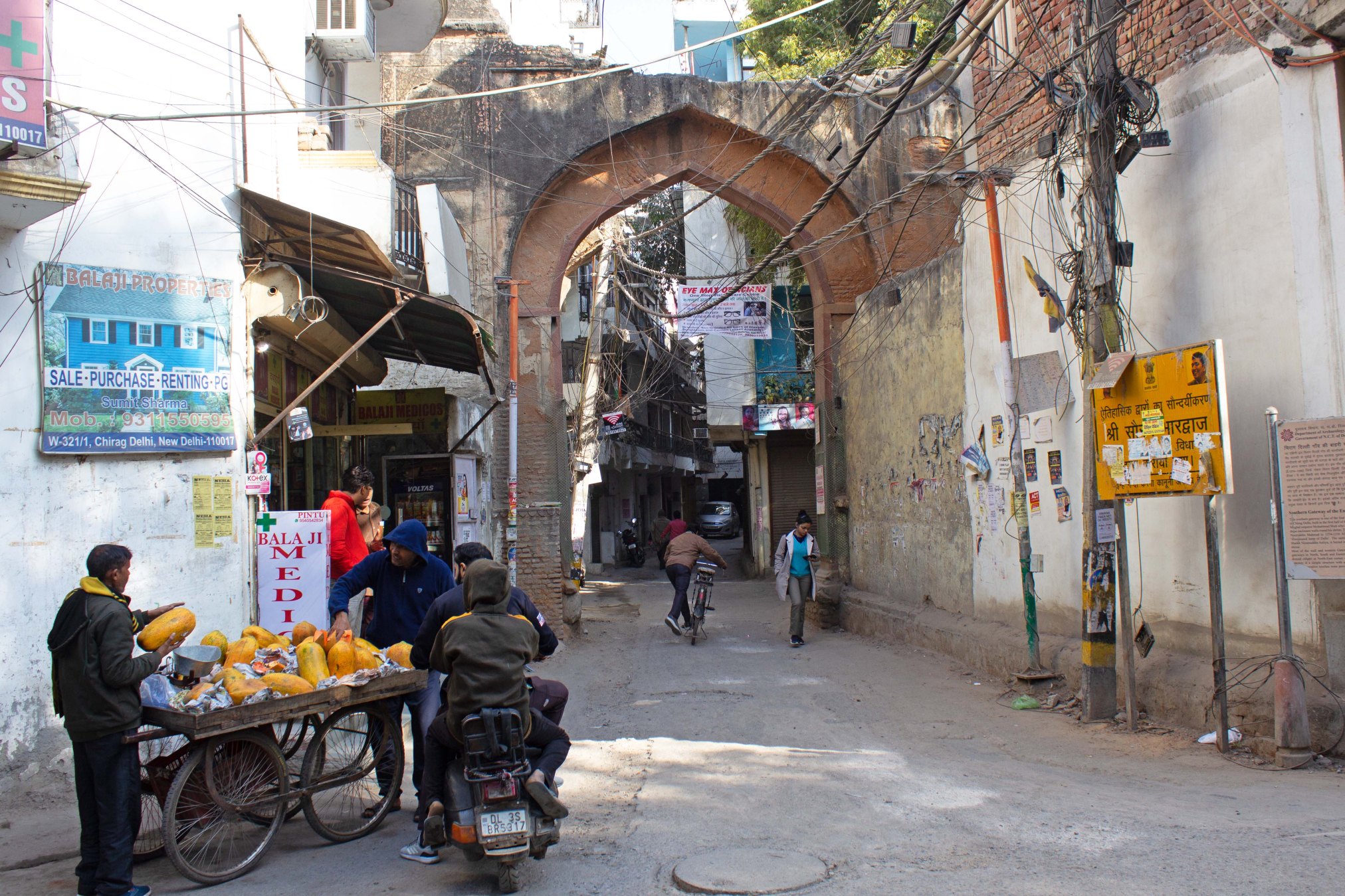
Entering Chirag Dilli. The crumbling gateway above dates from the early 18th century, when a wall, most of which is now gone, was erected around the dargah. This was built by Muhammad Shah Rangila, one of the later Mughal emperors, who presided over an empire that was very much in decline. Even here, you can see that the wall is quite feeble when compared with Mughal defensive architecture from a few centuries earlier (much of which remains very much intact). Likely this was not built to defend the site from military adversaries, but rather to secure the site from common threats like thieves and wild animals, as well as simply delineating the sacred space. Sadly, in photos of this spot from as recently as 2004, much more of the gate and wall is visible. Since then, Chirag Dilli has spilled outwards from the gate, and much of the late-Mughal architecture has been lost.

It’s only after much twisting and turning through the narrow alleys of Chirag Dilli that one comes out into the open space that encompasses the tomb.
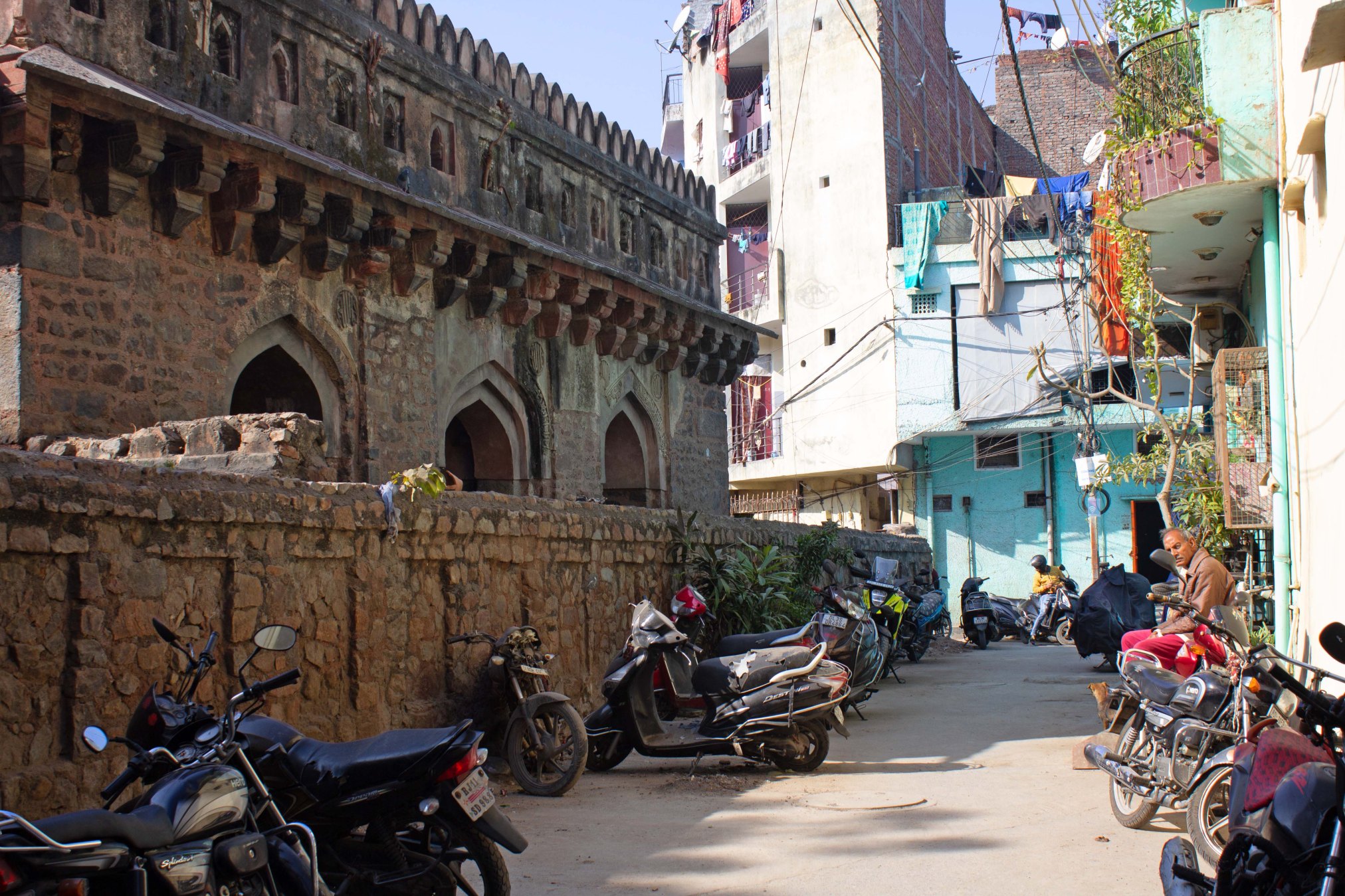
15th century masonry and motor bikes. Only a few generations ago, Chirag Dilli was a village out on the environs of Delhi, surrounded by forests and agricultural fields. But Delhi grew around the village, swallowing it with an IIT campus, shopping centers, and upscale neighborhoods. Yet, inside Chirag Dilli, the layout of the streets, which were not planned for automobiles, hasn’t changed. As a result, the preferred means of conveyance inside the village remains motorbikes rather than cars.

While the tomb is technically protected by the Archeological Survey of India, its grounds also serve as a public space for the people of Chirag Dilli…along with a rest area for dogs and a place to dry laundry!


Remnants of original 15th century plasterwork Arabic calligraphy around one the arches of the tomb…and a clothesline.

Inside the tomb, looking out over two large graves.

Steps up to the roof of the tomb, and curious dog.
If you enjoyed this post, please consider supporting me on my Patreon page. There, you can download an extended edition of my book The Green Unknown which includes several chapters available exclusively on Patreon.

 Patrick Rogers